

🇪🇸 Non-Lucrative Visa Spain 2025: Complete Guide to Living in Spain Without Working

Updated October 2025
Thinking about moving to Spain to enjoy the lifestyle, sunshine, and culture — without needing a job offer? The Non-Lucrative Visa Spain (also called Residencia no Lucrativa) allows you to live in Spain long-term if you can support yourself financially. In this guide, we’ll explain what the visa is, who it’s for, all 2025 requirements, how to apply, renew, how to avoid posible denials and related costs to account for— so you can start planning your move with confidence.
⚖️ What Is the Non-Lucrative Visa for Spain?
The Non-Lucrative Visa is a residence permit designed for non-EU citizens who want to live in Spain without working or running a business.
It’s perfect for:
- Retirees who receive a pension or have sufficient savings and want to move to Spain.
- People with passive income, such as investments, rental income, or dividends.
- Families who wish to relocate to Spain and can support themselves financially.
The visa is initially granted for one year, renewable for two years at a time, and after five years you can apply for long-term residence.
📋 Non-Lucrative Visa Spain Requirements (2025 Update)
To qualify, you must demonstrate financial independence and meet several documentation criteria.
💶 1. Minimum Income or Savings
You must prove sufficient economic means for the first year of residence:
- Main applicant: at least 4× the IPREM (around €30,500 per year in 2025).
- Each dependent: +1× IPREM (approx. €7,600 per year per family member).
Accepted proof includes:
- Bank statements for the last 6–12 months.
- Investment statements or pension proof.
- Notarized letters confirming regular passive income.
💡 Tip: Funds should be in your name and easily accessible from Spain.
🏥 2. Private Health Insurance
You must hold comprehensive private health insurance valid in Spain — with no co-payments or waiting periods. The policy should be valid for at least one year.
🪪 4. Clean Criminal Record
Submit a police clearance certificate from every country you’ve lived in during the last five years, apostilled and translated into Spanish.
🩺 5. Medical Certificate
Provide a doctor’s certificate confirming you are free from contagious diseases that could pose public-health risks according to International Health Regulations (IHR, 2005).
📄 6. Valid Passport
Your passport must be valid at time of application.
⚠️Common Misunderstandings: Non-Lucrative Visa 🆚 Digital Nomad Visa:
Many people — and even some lawyers — promote the Non-Lucrative Visa as if it allows you to live in Spain and continue working remotely for a foreign company.
That’s not true.
Under Spanish immigration law, this residence permit is meant strictly for people who do not perform any professional or economic activity, even if the work is done online and paid abroad.
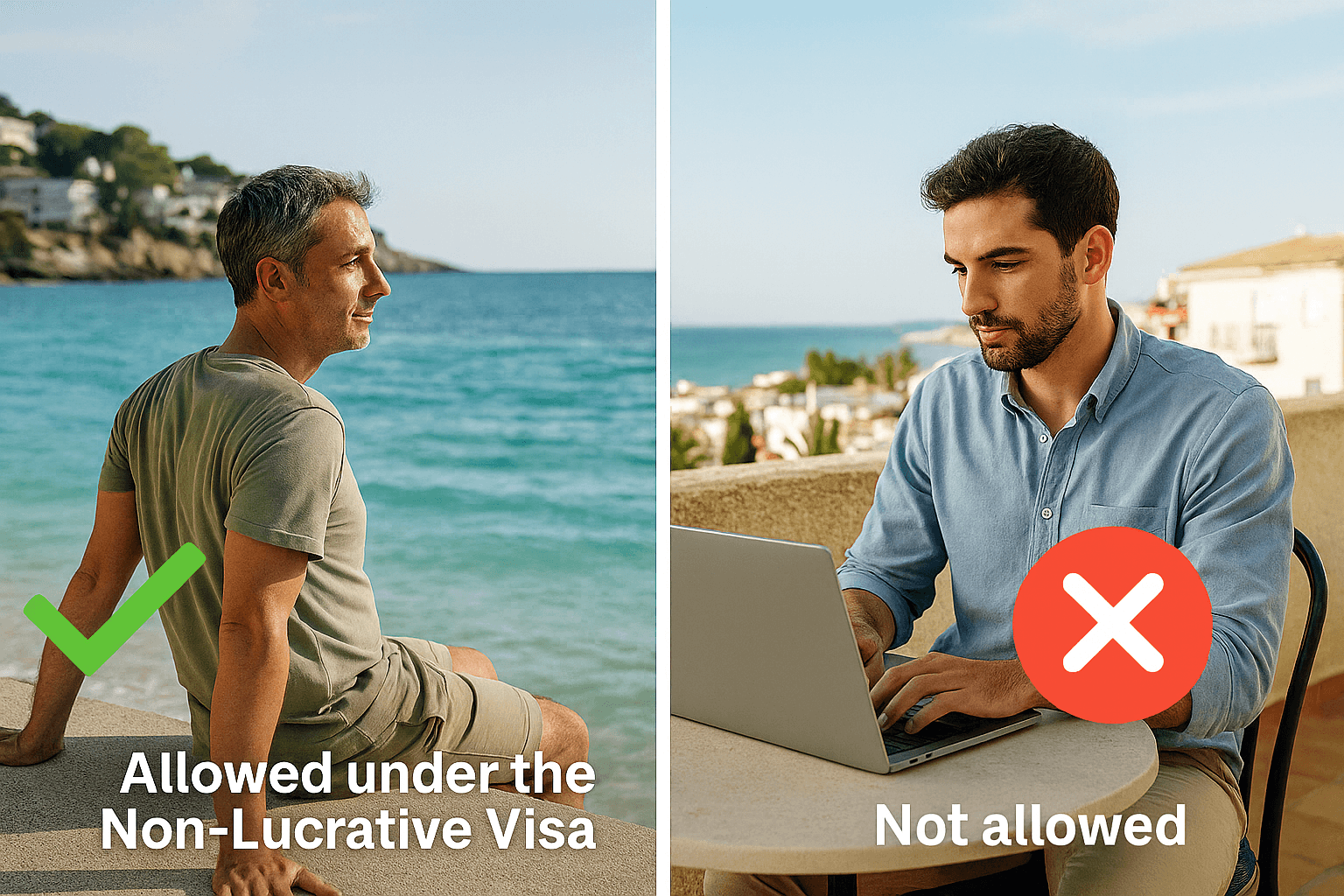
Beyond the legal issue, there are practical consequences too:
- You can’t register or pay into Spanish Social Security, so you won’t build a retirement fund.
- You’re not covered by Social Security healthcare, relying entirely on private insurance instead.
If you want to work remotely while living in Spain, the correct option is the Digital Nomad Visa, which explicitly authorizes teleworking and allows you to contribute to the Spanish system.
| Purposes | Non-Lucrative Visa | Digital Nomad Visa |
|---|
| Main Purpose | Live in Spain without working | Live in Spain while working remotely |
| Work Allowed | ❌ No — Any remote or local work is prohibited by law. | ✅ Yes — remote work for foreign employers or clients is allowed. |
| Who It’s For | Retirees, investors, or financially independent expats. | Remote workers, freelancers, and digital professionals |
| Income Type Accepted | Passive income (pensions, investments, savings ). | Active income from non-Spanish companies |
| Minimum Income (approx.) | 4× IPREM per month (plus +1× IPREM for each dependent) | 200% of SMI per month (Salario Mínimo Interprofesional) |
| Tax & Social Security | No Social Security contributions NO retirement fund or state coverage and NO Beckham Law tax benefits. | Contributes to SS & may access Beckham Law tax benefits depending on situation. |
| Best For | Retirees and investors | Remote workers and freelancers |
💡 In short:
The Non-Lucrative Visa is ideal for those who want to live in Spain without working, while the Digital Nomad Visa is designed for people who work remotely as freelancers or for foreign companies — legally and with full tax compliance.
🧾 Step-by-Step: How to Apply for the Non-Lucrative Visa Spain
- Prepare your documents.
Gather all required documents, legalized with apostille and translated by a sworn translator . - Submit your application.
Apply in person at the Spanish Consulate of your country of residence. - Pay the visa fee.
Usually between €80–€150, depending on nationality. - Wait for approval.
Decisions typically take 4–8 weeks. - Enter Spain and obtain your TIE card.
Within one month of arrival, register your address and apply for your TIE (Foreigner ID) at the police station.
💰 How Much Does the Non-Lucrative Visa Cost in 2025?
The following are approximate costs to give you a realistic idea of what’s involved in obtaining the Non-Lucrative Visa. These figures can vary depending on your country of residence, the number of documents to translate or legalize, and whether you work with or without professional assistance.
| Item | Estimated Cost (€) |
|---|---|
| Consular visa fee | 60–120€ |
| Document translations by sworn translator (per page) | 50–70€ |
| Apostilles and legalizations | 30–100€ |
| Spanish private health insurance (annual) | 400–1,200€ |
| TIE card tax (Spanish residence ID Tax) | 16€ |
| Visa assistance by a lawyer or immigration firm | 900–1,500€ (medium to high range, depending on complexity and family members) |
💡 These amounts are approximate and intended as a guide. Actual costs vary based on nationality, local fees, and personal circumstances.
Beyond the visa process itself, you should also consider housing and relocation expenses, which can vary widely depending on your lifestyle, preferred region, and level of professional support.
These can include:
- Housing costs: rent or property purchase, security deposits, utilities setup, and real estate agency fees.
- Relocation support: help finding a home, opening a bank account, registering at the town hall (empadronamiento), or arranging internet and local services.
- Lifestyle factors: whether you prefer city life, coastal areas, or small towns — prices can change dramatically depending on the region.
At ForExpats, many clients choose to get help not just with the visa, but also with the on-the-ground relocation, including advice on where to live in Spain, connecting with local agents, and ensuring everything is properly registered once they arrive.
💬 If you’d like to know approximate housing prices and what to expect when choosing where to live, check out our other post: 👉 Coasts of housing in Spain – Non-Lucrative Visa Edition
🔁 How to Renew the Non-Lucrative Visa in Spain
Your first renewal is after one year, and it grants two additional years of residence.
To renew, you must:
- Still meet the financial means (double the initial amount for two years).
- Maintain valid health insurance.
- Prove continued residence in Spain for at least 183 days within the year.
- Have no criminal record in Spain nor abroad.
🕓 Apply 60 days before your residence card expires or up to 90 days after.
⚠️ Why Did My Non-Lucrative Visa Get Denied? | Common Mistakes
Visa refusals are more common than most people think — and in nearly all cases, they happen for avoidable reasons.
Here are the most frequent mistakes that lead to a denial:
1️⃣ Not working with an immigration lawyer or expert: Beyond understanding the procedure, immigration lawyers have direct communication channels with Spain’s immigration offices. Even for initial consular applications, a lawyer ensures that the documentation fully meets the Spanish requirements and avoids rejections for missing or inconsistent paperwork.
2️⃣ Insufficient or unstable funds: Bank balances that fluctuate heavily or don’t meet the minimum required amount. The authorities want to see consistent and reliable access to funds, not temporary transfers or last-minute deposits.
3️⃣ Health insurance that doesn’t meet legal standards: The policy must be with a Spanish insurer, have no co-payments, and provide full coverage including repatriation to your home country. Many applications are denied because the insurance plan is international, limited, or lacks the correct wording.
4️⃣ Missing translations or expired documents: Every foreign document must be translated by a sworn translator.
5️⃣ Applying at the wrong consulate: You must apply at the Spanish consulate that has jurisdiction over your official place of residence.
6️⃣ For renewals, not proving double the initial economic funds: When you apply for your first renewal, you’re requesting a two-year residence permit, not one. That means you must prove twice the initial financial amount (8× IPREM for the main applicant, plus 2× IPREM for each dependent).
7️⃣ (New) Not residing in Spain at least 183 days during the first year: The Non-Lucrative Visa is intended for people who genuinely reside in Spain. If you spend less than 183 days in the country during your first year, your renewal will be denied.
8️⃣ Providing outdated certificates: All documents must be issued within the last 90 days before submission.
9️⃣ Not providing apostilles for all official documents: Every document issued outside Spain must be apostilled or legalized to be valid before Spanish authorities.
🔟 Criminal record misunderstandings: We’ve encountered cases where applicants had no criminal record, but did have police records from detentions that never led to charges. In countries like the U.S., these can appear on background checks and be mistaken by Spanish authorities as criminal convictions. When this happens, it’s important to appeal and clarify the difference with certified documentation so the visa can be approved.
If your Non-Lucrative Visa is denied, you have the right to file an appeal or submit a new application once the issues have been corrected.
💡 Tip: If you’ve received a denial, it’s often worth having a professional review the decision — sometimes the issue is procedural and can be resolved quickly without starting from zero.
🏡 Life After the Non-Lucrative Visa
Once you’ve completed your first year of residence in Spain with the Non-Lucrative Visa, you’re no longer limited to this permit type. When your first card expires, you can modify your status directly into another type of residence — such as:
- a work permit (cuenta ajena) for a salaried position,
- a self-employed or freelance permit (cuenta propia),
- a student visa if you decide to pursue studies, or
- other residence options available under Spain’s immigration law.
If you choose to remain under the Non-Lucrative Visa, after five years of continuous residence you may apply for long-term residence (residencia de larga duración), which grants you more stability and fewer renewal requirements.
💡 In short: once you’re inside the Spanish immigration system, new and more flexible opportunities open up — turning the Non-Lucrative Visa into the perfect first step toward a longer-term plan in Spain.
💬 Final Thoughts
The Non-Lucrative Visa Spain is one of the most popular residence options for retirees, investors, and families who want to enjoy life in Spain legally and peacefully. It’s also a straightforward pathway to obtaining your first residence card — often the most challenging step in the immigration process.
I always tell my clients that once you’re inside the Spanish immigration system, everything becomes easier. After securing your first residence card, new options open up — with fewer requirements and more flexibility for renewals, work permits, or long-term residence.
👉 Need help with your visa or relocation? Contact us or book a consultation to get personalized guidance.
🇪🇸 Spain Visa & Living FAQs
START RIGHT NOW
Get Expert Guidance from Núria and her team.



I’m curious about the mechanics behind Sprunki, but FEED DURPLE??. Is there a hidden combo? The visuals during the transition look sus, like there’s an easter egg. Love it!
As someone who’s played many Sprunki mods, Sprunki Phase 4.5 Definitive (My Take) finally nails the difficulty curve. The new mechanics add strategic depth without being overwhelming. GG to the devs!
Mastering Sprunki Phase 4.5 Definitive (My Take) is so rewarding. The music sync with the enemy patterns (or animations) is chef’s kiss. Pro tip: watch for the tempo changes!